Firestartr#
Firestartr is an internal developer platform. It gives an organization one explicit map of its software — and of the people responsible for it — and then acts on that map to create and maintain the repositories, pipelines, and infrastructure the software needs.
When software outgrows the organization#
It usually starts small: a few repositories, and everyone knows who owns what. As teams and products multiply, that shared understanding disappears.
- Every repository grows its own CI/CD setup, with little convention across them.
- The architecture becomes opaque: nothing describes how the pieces relate.
- Permissions accumulate person by person, so responsibility turns diffuse.
The software still runs, but the organization no longer has a model of it. Firestartr makes that model explicit before automating anything on top of it.
A map the business can recognize#
Firestartr organizes software in layers that match how the business actually works.
Domains#
A domain groups the systems that serve one part of the business. In an online store,
a commerce domain covers the buying experience end to end.
Systems#
A system is an explicit grouping inside a domain, with its own responsibility. The
commerce domain splits into an inventory-system (catalog, search, and stock) and a
checkout-system (cart, orders, and payments). The boundary is deliberate: each system
owns a coherent slice of the product.
Components#
A component is a unit of software together with its repository. The system it belongs to gives it a place on the map, so nine repositories become nine known components in two systems instead of nine loose ends.
Teams and ownership#
Responsibility is part of the map. People are grouped into teams, and each team owns the components of a system: an inventory team owns the inventory components, a checkout team owns the checkout components. Ownership is exactly that — who answers for a component, its changes, and its operation.
Features: the stack each component needs#
Components are not empty repositories. A feature adds the files and workflows a
repository needs, so teams adopt a capability instead of hand-rolling it. Typical
features cover Docker image builds and automated releases with release_please.
Applying a feature is where the map becomes concrete: a component plus its features
behaves the way the organization expects.
Supporting infrastructure#
Software also depends on resources that are not code: a bucket for a frontend’s static files, a queue, a managed database. Firestartr keeps this supporting infrastructure next to the component that uses it and provisions it with Terraform. The component keeps its place, its owner, and its features, while the infrastructure remains part of the same picture instead of drifting into an unowned set of cloud resources.
Three control surfaces#
People do not need another tool to log into. Firestartr meets them on the surfaces they already use:
- GitHub — where code, reviews, and workflows live.
- Backstage — where the catalog of services and ownership is browsed.
- Skill — the conversational surface that turns a request into Firestartr instructions.
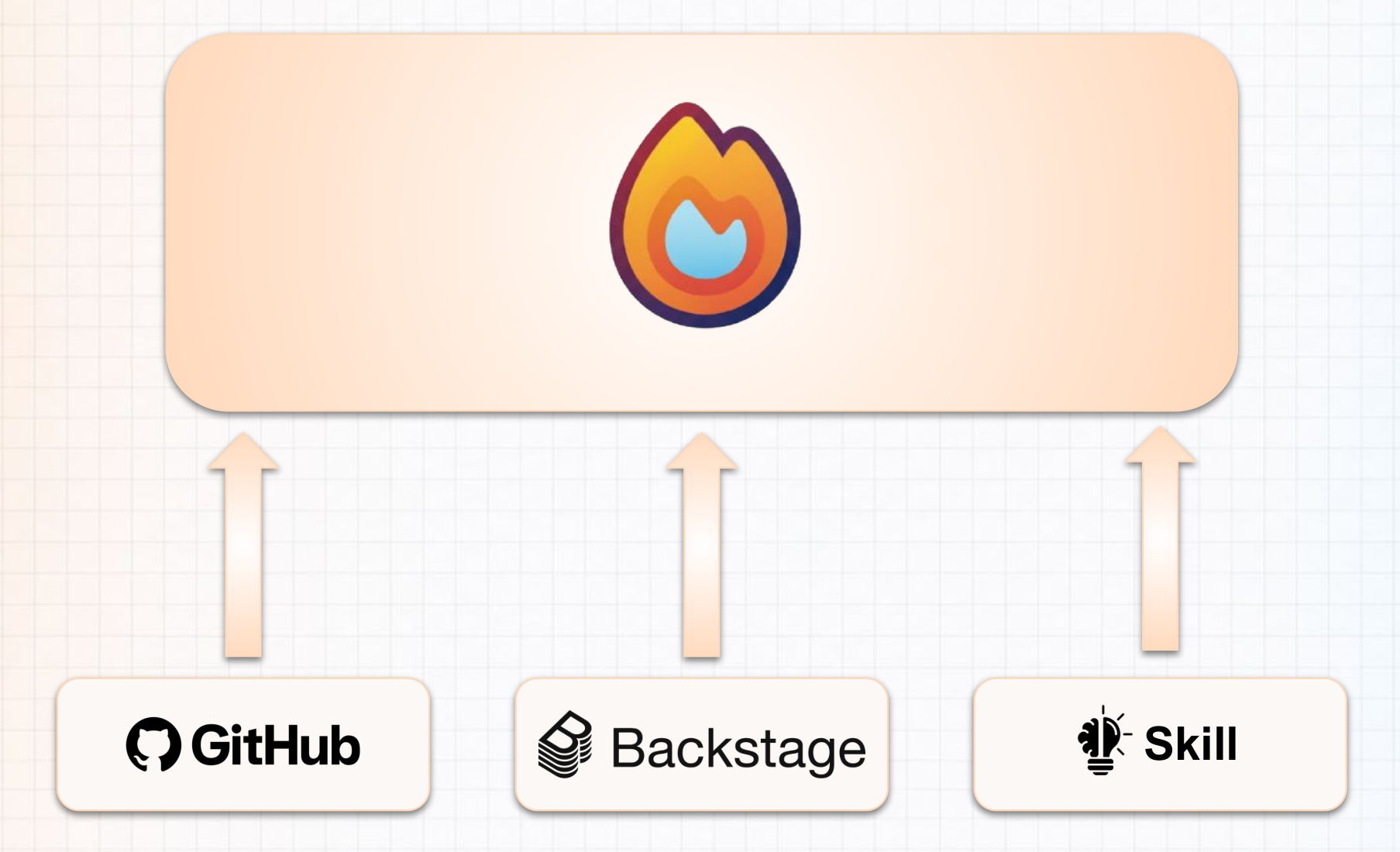
All three drive the same platform, so a change made from any of them is reflected in the same model.
How the Skill carries instructions#
The Skill does not act directly. An instruction travels a path of three stages:
- fs-forge — the step that issues the instruction to Firestartr.
- agent — interprets the instruction against the map and works out what must change.
- skill — carries the change out against the mapped components, using their features and supporting infrastructure.
Because every stage works from the same map, the result stays consistent with the organization’s structure instead of drifting away from it.
Where to go next#
- Deploying resources — practical guides for the repositories Firestartr manages:
the
.firestartrconfiguration repository, the application and system-service state repositories, claim validation, and migration. - Providers — documentation for the providers that back claims, including the Terraform provider.
- Features — the catalog of features you can apply to repositories.